REVIEW · SEDONA
The Perfect Grand Canyon Tour with Local Expert Guides
Book on Viator →Operated by Scenic Sedona Tours · Bookable on Viator
The Grand Canyon, minus the stress. This 9-hour Sedona tour strings together the South Rim must-sees with local guides, smart timing, and easy round-trip van transport.
I love two things most: the air-conditioned minivan (no parking hunt) and the way the guide keeps each stop meaningful, from Hopi House craft traditions to Mary Colter’s iconic designs. Seeing it all from several viewpoints without rushing is a real win.
One fair heads-up: the day is long, and the rim terrain is uneven. Plus, the van can feel tight for tall riders, so plan for limited legroom.
In This Review
- 6 Things That Make This Grand Canyon Tour Feel Like a Win
- From Sedona to Flagstaff: The Road Trip Warm-Up
- The Value of a Guided Highlights Loop (Not a Random Sight-Seeing Dash)
- Hopi House: Craft, Concessions, and Mary Colter’s First Big Statement
- Kolb Studio: Ellsworth and Emery Kolb at the Canyon Edge
- Mather Point: Your First Real Canyon Shock (and a Great Way to Orient)
- Desert View Watchtower: Mary Colter’s 70-Foot Story on the East Side
- Yavapai Point and the Geology Museum: How to Make Sense of the Rocks
- Lipan Point (Moran Point): Photo-Friendly Views and Thomas Moran’s Legacy
- The Drive Back to Sedona: Relaxing Time After a Long Day
- Who This Tour Fits Best (and Who Should Consider Another Plan)
- Should You Book This Sedona to Grand Canyon Highlights Tour?
- FAQ
- What time does the tour start, and where do we meet?
- How long is the tour?
- What’s the price per person?
- How big is the group?
- Is the tour in English?
- What’s included at the stops?
- Do I need good weather for this experience?
- Are service animals allowed?
6 Things That Make This Grand Canyon Tour Feel Like a Win
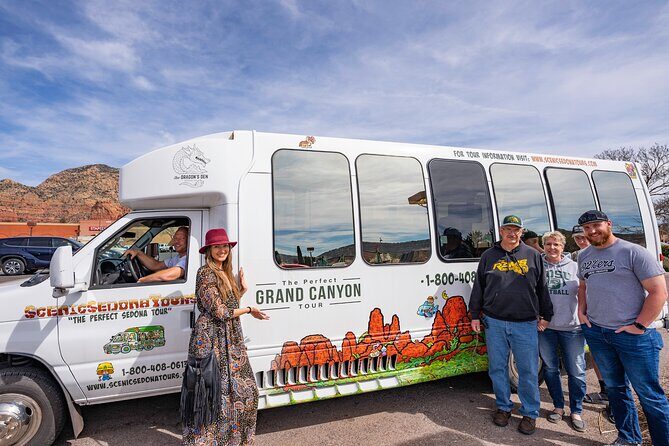
- Small group size (max 14): more personal pacing and easier help at stops
- South Rim highlights in one loop: Mather Point, Yavapai Point, Desert View, and more
- Hopi House and Kolb Studio included time: not just viewpoints, but stories behind them
- Yavapai Point Geology Museum stop (50 minutes): best time on the trip for rock-layer explanations
- To-go lunch stop in Flagstaff: grab-and-go before you look out over the canyon
- Multiple guides are excellent at comfort: I’ve seen examples of guides adjusting to knee issues and easing fear of heights
From Sedona to Flagstaff: The Road Trip Warm-Up
This starts early, with an 8:00 am departure from 1710 W State Rte 89A in Sedona. The schedule is built around getting you to the Grand Canyon while daylight is still friendly for views and photos.
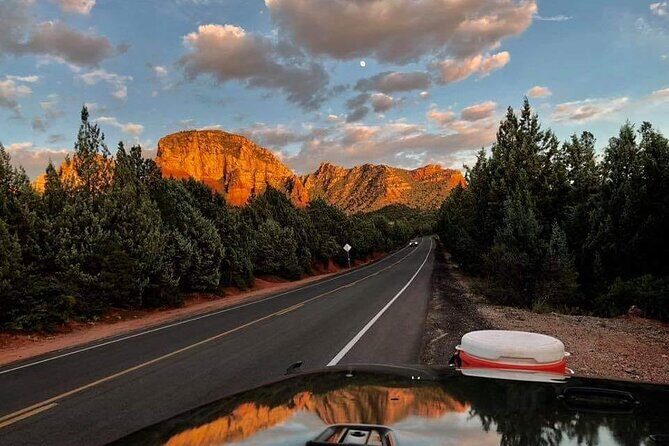
First, you head to Flagstaff with a comfort-first drive. Along the way, you go through Oak Creek Canyon Scenic Drive (Route 89A), a famous stretch between Sedona and Flagstaff. It’s about 24 miles and drops roughly 4,500 feet from the Mogollon Rim. In plain terms: you get changing scenery fast, so you’re not just “traveling”—you’re warming up for what’s coming.
When you reach Flagstaff, there’s a stop at Kickstand Kafe. You’ll stretch your legs, use the restroom, and pick up a to-go lunch. The lunch is planned so you can enjoy it later while overlooking the Grand Canyon, which is a nice way to avoid that on-the-road scrambling feeling.
Then you continue the drive toward the park area. The timing is set so you’re not stuck with a half-day of transit and no payoff. The goal here is simple: get you to several South Rim highlights without spending hours figuring out where to park and which viewpoints are actually worth the walk.
Other Grand Canyon day trips from Sedona

The Value of a Guided Highlights Loop (Not a Random Sight-Seeing Dash)
A Grand Canyon day can go sideways if you self-drive: parking lines, crowds, “where are we going next?” stress, and the classic trap of seeing one viewpoint well and the rest poorly.
This tour is built to avoid that. It’s a guided South Rim highlights loop with air-conditioned van transport and intentional time blocks at each stop. That means you can focus on what you came for—views—while your guide handles the flow and the context.
You also get local guide narration. People talk a lot about the Grand Canyon being huge. The guides take it further by tying what you see to geology and human history: the rock layers, the Colorado River’s path, and the design choices of Mary Colter in structures like Hopi House and Desert View Watchtower.
And because it’s a max of 14 travelers, the day feels less like a cattle-car tour. You’re still doing a full itinerary, but the pacing is more human.
Hopi House: Craft, Concessions, and Mary Colter’s First Big Statement
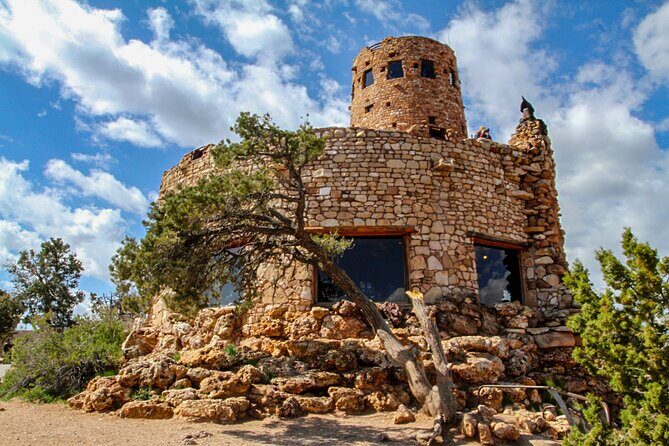
One of the most distinctive stops is Hopi House. You get about 40 minutes here, and admission time is included.
What makes Hopi House special is that it’s not just a gift-shop stop. It’s modeled after traditional Hopi pueblo dwellings, inspired by the idea of a 1,000-year-old village style. The building itself dates to the early 1900s, built in 1904 as concessioner facilities at the South Rim, with Hopi House opening January 1, 1905.
It was designed by Mary Colter, and it also connects to the Fred Harvey Company, which played a major role in shaping visitor experiences across the Southwest. The concept was clear: offer Native American crafts, with the Hopi chosen as the featured artisans, and design the building so it resembles a traditional pueblo rather than feeling like a generic trading post.
For you, this means you leave the stop with more than photos. You understand why it looks the way it looks, and why it became an early fixture for visitors who wanted a cultural stop alongside the canyon views.
Tip for your time here: treat it like a mini museum-and-market combo. Look first at how the structure is put together, then spend time with crafts and materials. The contrast between architecture and objects makes the whole stop click.
Kolb Studio: Ellsworth and Emery Kolb at the Canyon Edge

Next up is Kolb Studio, about 30 minutes with admission included.
At first glance, Kolb Studio can look like an old building perched near the rim—easy to skim past if you’re only chasing the biggest overlook. But the interior and context change that. It was operated from 1904 to 1976 as the photographic studio of Ellsworth and Emery Kolb.
This is where the tour connects the canyon to people who documented it for others. The Kolb brothers helped build a lasting legacy of canyon photography and storytelling—so when you look out over the canyon after, you’re not just seeing scenery. You’re seeing a place that early photographers worked to interpret.
If you’re the type who likes “how did this place become famous?” stops, Kolb Studio is a strong one. It also helps break up the day so you’re not only standing at viewpoints.
Mather Point: Your First Real Canyon Shock (and a Great Way to Orient)

For most people, Mather Point is the “whoa” moment. You get around 30 minutes here, with the South Rim visitor area nearby.
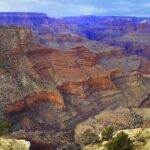
Mather Point is often the first big look at the canyon from the South Rim—short walks from the Visitor Center area and parking lots. On clear days, the view can stretch 30+ miles east and 60+ miles west, and you can spot a few glimpses of the Colorado River along with Phantom Ranch far below, plus trails threading across the terrain.
This stop is also valuable for orientation. After Mather Point, the other viewpoints make more sense because you start to recognize where major features sit relative to each other.
If you want photos, go early in the 30 minutes, then spend the back half looking without a camera. The canyon’s scale can be hard to absorb in “photo mode” only.


Desert View Watchtower: Mary Colter’s 70-Foot Story on the East Side
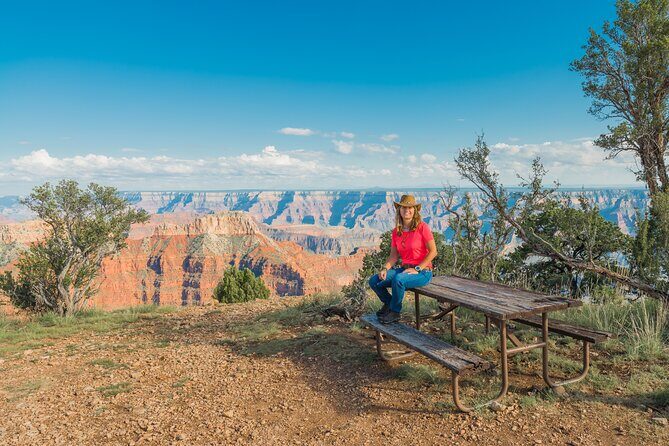
The trip also includes Grand Canyon Desert View Watchtower, about 30 minutes with admission included.
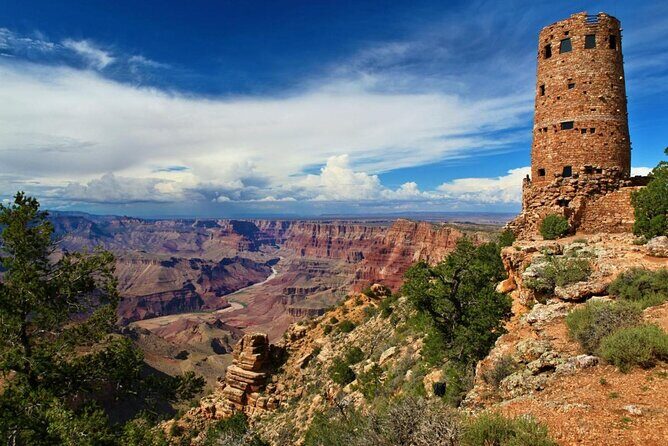
This one hits different because it’s both a view platform and an architectural story. The watchtower is a 70-foot-tall circular stone structure built in 1932, designed by Mary Colter for the Fred Harvey Company. From a distance, it can look like an ancient ruin, but it’s a deliberately planned building.
It sits near the eastern edge of the park where the Colorado River begins to turn north and where the Painted Desert stretches toward the Navajo and Hopi Reservations. So your view isn’t just “the canyon.” You also get that wider sense of Southwest geography that makes the Grand Canyon feel like the main character in a much larger story.
Also, this is a strong stop for anyone who likes design details. Colter’s work shows up repeatedly across Grand Canyon structures, and the tour’s timing gives you a chance to compare styles rather than treating each building as a random photo spot.
Yavapai Point and the Geology Museum: How to Make Sense of the Rocks
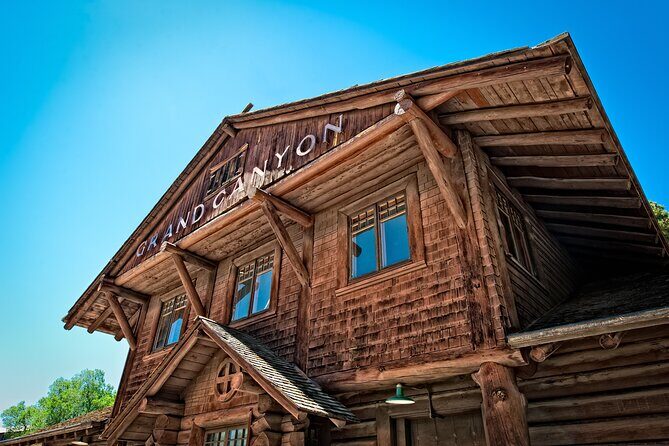
If you want one stop that helps you understand what you’re looking at, make it Yavapai Point. You get about 50 minutes, and admission is included.
Yavapai Point includes Yavapai Geology Museum, with panoramic windows and annotated displays that show you where to look for different rock groups. The museum also helps you connect the visible layers to the names of rock formations and the geologic timeline they represent.
Here’s why that matters: if you only look at the canyon as a pretty view, it can feel like a blur of color and depth. This stop gives you something concrete—rock layers, models, and explanations—so the canyon starts to read like a real timeline.
You can also walk between rock column models of the North and South Rims. That’s a simple move, but it helps your brain stop guessing and start recognizing.
If you’re short on time elsewhere in your life, this is the one spot you’ll be glad you didn’t skip.
Lipan Point (Moran Point): Photo-Friendly Views and Thomas Moran’s Legacy
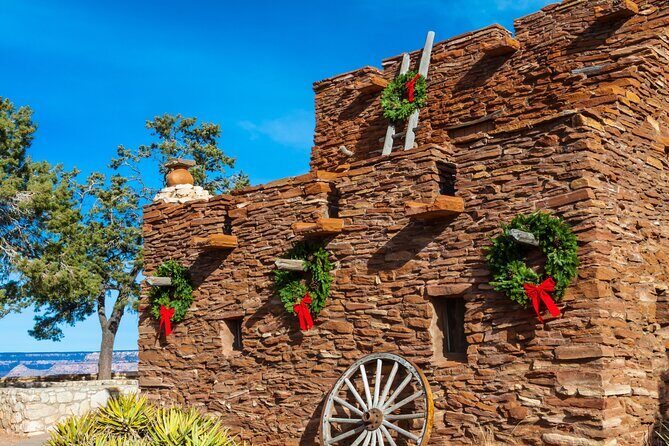
The last major viewpoint stop is Lipan Point, described with the qualities of Moran Point—a popular South Rim photo spot on the east rim drive.
This area is known for far-reaching views over a wide section of the canyon, and it’s also a great spot for group photos because you get a broad “front row” view. The description places it roughly between river miles 87 and 72, and notes how it’s connected by a short spur road.
It also comes with a name story. Moran Point is tied to painter Thomas Moran, who first came here in 1873 and helped popularize the canyon. That popularity is linked to the canyon’s path to being protected: it led to a national monument designation in 1908 and then a national park in 1919.
Even if you don’t care about the history, the viewpoint itself gives you a final chance to see the canyon from a different angle before the drive back.
The Drive Back to Sedona: Relaxing Time After a Long Day
After the viewpoints, you get time to relax on the return trip. The schedule builds in about 2 hours 30 minutes for the ride back to Sedona, so you’re not dealing with “one more thing” at the end.
This matters because a Grand Canyon day is physically demanding. Even on a highlights tour, you’ll do a lot of standing and walking, and rim areas can be uneven underfoot. Plan on comfy shoes and pace yourself. The guides do a good job helping people step in and out smoothly, which helps a lot when everyone’s trying to take photos at the same time.
Also, if you’ve got a fear of heights or a sensitive knee, I’d expect the guide to help you manage your comfort level at overlooks. I’ve seen examples of guides being supportive and adjusting the day without turning it into a big production.
Who This Tour Fits Best (and Who Should Consider Another Plan)
This is a great fit if you:
- want major South Rim viewpoints in one day
- don’t want to deal with parking and routing
- like learning stories behind what you see, not just snapping pictures
- appreciate a small group instead of a huge bus
You might want to think twice if:
- you’re very sensitive to uneven terrain and long walks on the rim
- you’re tall and really need more legroom in the van
- you want a full sit-down lunch experience (the day includes a to-go lunch, not a long restaurant stop)
Should You Book This Sedona to Grand Canyon Highlights Tour?
If you want the South Rim’s big moments without the day unraveling, I’d book it. The mix of viewpoints plus timed stops with included access—Hopi House, Kolb Studio, Desert View Watchtower, and the geology at Yavapai Point—makes the day feel purposeful, not random.
I’d especially lean toward it if you’re short on time in Arizona or you’d rather spend your energy on the canyon than on logistics. Just go in ready for a full-day experience: plan for walking, bring comfort in your footwear, and assume the van may feel snug if you’re long-legged.
If you’re okay with that trade, this tour is one of the more efficient ways to see a lot of the Grand Canyon in a single, guided loop from Sedona.
FAQ
What time does the tour start, and where do we meet?
The tour starts at 8:00 am at 1710 W State Rte 89A, Sedona, AZ 86336. It ends back at the same meeting point.
How long is the tour?
The tour runs about 9 hours (approx.).
What’s the price per person?
The price is $189.00 per person.
How big is the group?
The tour has a maximum of 14 travelers.
Is the tour in English?
Yes, the tour is offered in English.
What’s included at the stops?
Admission tickets are included at Hopi House, Kolb Studio, Mather Point, Grand Canyon Desert View Watchtower, Yavapai Point, and Lipan Point (as described for the Moran Point area). You’ll also have a stop at Kickstand Kafe in Flagstaff for restroom access and a to-go lunch.
Do I need good weather for this experience?
Yes, it requires good weather. If it’s canceled due to poor weather, you’ll be offered a different date or a full refund.
Are service animals allowed?
Yes, service animals are allowed.